
Nasdaq: VIVS
is Revolutionizing New Drug Discovery & Development. and could save pharma $50–$200M+
VIVS management expects more than 500% revenue growth in FY2027.
VivoSim Labs (Nasdaq: VIVS) helps pharmaceutical companies predict drug toxicity and side effects early in the development process, using human 3D liver and intestinal tissue models, allowing them to identify unsafe drug candidates sooner, choose better compounds to advance, and potentially avoid wasting tens of millions of dollars and years developing drugs that ultimately fail.
- Human 3D Tissue Models
- Pharmaceutical Contract Research
- Liver + Intestinal Toxicology
- Human 3D Tissue Models
- Pharmaceutical Contract Research
- Liver + Intestinal Toxicology
Drug discovery begins with abundance - up to 10,000 compounds to develop one drug.
Success comes from elimination.
Traditional drug development can require millions of dollars and years of research before a candidate’s human toxicity risks are fully understood. When those risks emerge late, much of the time and capital already invested may be lost.
VivoSim is working to provide that critical information earlier.
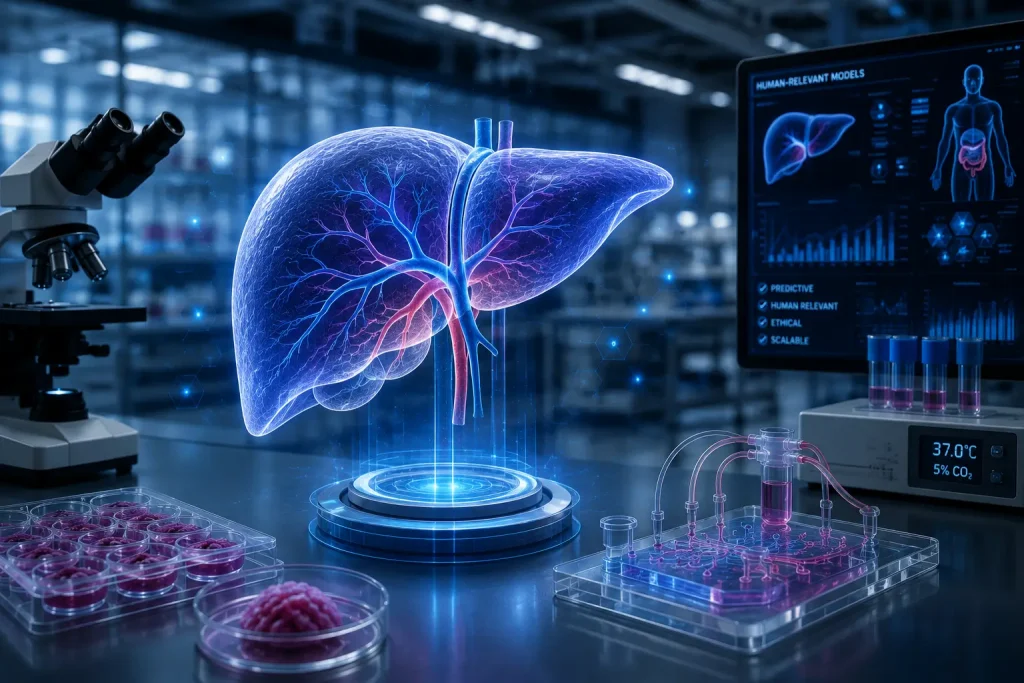
Using advanced 3D human-relevant models, VivoSim’s NAMkind™ platform is designed to identify potential toxicity during earlier stages of drug development—helping pharmaceutical companies make better-informed decisions about which candidates to advance, optimize or discontinue before development costs escalate.
Management Guidance
With that industry and regulatory shift underway, VivoSim management is guiding for more than 500% revenue growth in FY2027 as its services gain commercial traction with pharmaceutical customers.
The goal is simple: identify potentially toxic candidates while the cost of changing direction is still relatively low—not after millions have already been committed.
Every drug developer faces this problem, and demand for better early-stage testing is increasing as the FDA pushes the pharmaceutical industry toward more human-relevant testing methods and reduced reliance on animal studies.
THE REVENUE OPPORTUNITY
Two Core Commercial Markets
These are forward-looking company objectives, not current revenue. The broader presentation states management expects VivoSim could potentially reach approximately $50M–$100M of revenue within four to seven years.
Liver Toxicology
Reported Liver Model Overall Accuracy

Intestinal Side-Effect Prediction
Company revenue target

Combined Opportunity
Company-stated target period: 4–7 years
Two high value markets. One differentiated platform. Signifcant long-term commercial potential.
Reasons to consider
Eight Reasons NASDAQ: VIVS Stands Out
A Major Problem for Pharma
Drug failures consume enormous amounts of pharmaceutical R&D spending.
See Details
Predictive Human Models
VivoSim uses human 3D tissue models designed to identify toxicity that conventional testing can miss.
See Details
Strong Liver Model Performance
Company data report 92% overall accuracy with a 0% false-positive rate.
See Details
Expanding Into GI Toxicity
See Details
Attractive Pharma Economics
See Details
Large Commercial Opportunity
See Details
FDA Regulatory Tailwind
See Details
Scalable CRO Model
See Details
Investor Highlight
Find toxicity earlier. Reduce expensive failures. Give pharmaceutical developers better human-relevant information before clinical development becomes significantly more expensive.
OVERVIEW
Better Human Models. Smarter Drug Development.
VivoSim is focused on New Approach Methodologies (NAMs) — sophisticated non-animal models designed to more accurately represent how human tissues respond to pharmaceutical compounds.
Through its NAMkind™ contract research platform, VivoSim tests drug candidates for potential liabilities including drug-induced liver injury and gastrointestinal side effects.
The company argues that identifying these problems earlier can save pharmaceutical developers substantial amounts of capital and development time. Its presentation estimates that unsuccessful drug programs can consume $50 million to $200 million before toxicity is ultimately identified, while industrywide pharmaceutical R&D spending is expected to reach approximately $350 billion by 2029.
Human Biology, Not Simplified Biology
Built for Pharma
A Scalable Service Business
The commercial model includes fee-for-service testing, per-compound/per-assay pricing, FTE arrangements and research collaborations.
company Snapshot
The VivoSim Opportunity by the Numbers
Reported Liver Model Overall Accuracy
Why NASDAQ: VIVS stands out
A section-by-section breakdown of the operating base, the pivot, the playbook, and the setup.
01 · The Problem
Drug Development Is Expensive — and Failure Is Even More Expensive
Pharmaceutical companies invest enormous sums developing compounds that may ultimately fail because of toxicity.
VivoSim's presentation cites:
- Approximately $340 million as the cost of a typical drug-development program.
- Approximately $79 million in risk-adjusted failure cost.
- A 5% liver-toxicity failure rate.
- Approximately $3.7 million in expected liver-toxicity cost per development program.
Against those potential losses, VivoSim estimates its liver testing services at only approximately $25,000–$50,000 per program.
Why it matters
If VivoSim can help identify unsafe compounds earlier, pharmaceutical companies may be able to:
eliminate weak candidates sooner → concentrate capital on stronger programs → reduce development risk → potentially improve returns on R&D spending.
02 · The Technology
NAMkind™: Human 3D Tissue Models Designed to Predict Toxicity
VivoSim's liver platform uses donor-derived human cells incorporated into proprietary multicellular 3D models in 96-well plates.
The platform includes:
- Hepatocytes
- Stellate cells
- Kupffer cells
- Endothelial cells.
This multicellular structure is intended to recreate important elements of human liver biology and provide more meaningful information than oversimplified traditional approaches.
VivoSim's reported liver-model performance:
- 92% overall accuracy
- 88% selectivity
- 0% false-positive rate
The company states its models identify 87.5%+ of difficult-to-detect liver toxicity issues, including some liabilities missed by animal models and traditional testing.
03 · Real-World Validation
Can the Model Distinguish Dangerous Drugs From Safer Alternatives?
The presentation highlights several historical drug comparisons.
Troglitazone vs. Pioglitazone
Troglitazone was associated with severe drug-induced liver injury and was withdrawn from the market. VivoSim reports its model clearly identifies damaging effects on liver-cell function, while the structurally related and safer pioglitazone produces a much safer profile.
Trovafloxacin vs. Levofloxacin
The platform similarly distinguishes the liver toxicity associated with trovafloxacin from the safer profile of levofloxacin.
This is one of the strongest sections visually and I would reproduce the deck’s comparison charts here.
04 · Beyond the Liver
Building a Second Platform Around Gastrointestinal Toxicity
VivoSim has also developed a human intestinal model designed to predict gastrointestinal adverse effects.
The model contains:
- Human epithelial cells
- Smooth muscle cells
- Fibroblasts
- Endothelial cells
and incorporates features including polarized epithelium, tight junctions, specialized epithelial cells, CYP450 enzymes and functional transporters.
Reported GI-model performance:
- 96% overall accuracy
- 93% selectivity
- 3% false-positive rate
The company sees particular potential in oncology, where gastrointestinal tolerability can materially influence patient quality of life and differentiation among competing treatments.
05 · The Commercial Model
Multiple Ways to Work With Pharmaceutical Customers
VivoSim intends to customize its services around customer requirements rather than selling only a single standardized assay.
Fee-for-ServicePharmaceutical customers can screen compounds using VivoSim's models and pay:
-
per compound → per assay → per testing program
Applications can include screening, candidate prioritization and investigational toxicology.
FTE ProgramsLonger and more complex engagements can use dedicated full-time-equivalent models for:
- Investigational toxicology
- Bespoke assays
- Mechanism-of-action studies
- Custom model development.
Research CollaborationsVivoSim can work directly with pharmaceutical developers to expand endpoints and customize testing capabilities for individual drug-development programs.
06 · The ADC Opportunity
A Rapidly Growing Drug Class With a Significant Toxicity Problem
Antibody-drug conjugates — ADCs — represent a particularly interesting opportunity for VivoSim.
The company states:
of oncology pipelines have one or more ADCs.
Nearly 20
But the modality remains constrained by non-specific toxicity, including potential liver toxicity. VivoSim believes its liver models can provide valuable counter-screening of ADC candidates before companies commit substantially greater resources to clinical development.
The company also intends to develop solutions capable of supporting:
small molecules → antibodies → ADCs → gene therapies → other emerging therapeutic modalities.
07 · The Regulatory Tailwind
The FDA Is Moving Toward Human-Relevant, Non-Animal Testing
This deserves to be one of the most prominent sections on the page.
The FDA announced a new approach in April 2025 designed to modernize drug development and reduce reliance on animal testing.
According to the presentation, the initiative emphasizes:
- Human-relevant preclinical methods
- Cell-based testing
- Organoid toxicity assays
- New Approach Methodologies
- Improved predictive accuracy
- Faster drug evaluation
- Lower development costs
- Reduced reliance on animal experimentation.
Why the timing mattersVivoSim isn't trying to convince regulators to create a market for NAMs from scratch.
The company’s technology is being developed while regulators themselves are encouraging greater use of the category.
08 · The Economic Setup
A Small Testing Expense Against a Potentially Enormous Failure Cost
This may be VivoSim's strongest commercial argument.
According to the company presentation:
| Drug-development economics | Company estimate |
| Typical drug-development program | $340M |
| Risk-adjusted failure cost | $79M |
| Liver toxicity failure rate | 5% |
| Expected liver-toxicity cost per program | $3.7M |
| VivoSim liver testing service | $25K–$50K |
The investment argument is simple:
If tens of thousands of dollars of human-relevant testing can help reduce exposure to millions of dollars of potential failure cost, VivoSim doesn't need to replace the pharmaceutical development process — it only needs to become a valuable part of it.
COMPETITIVE POSITIONING
Designed to Combine Predictive Performance With an Attractive Price Point
The company presentation compares VivoSim with InSphero and Emulate.
According to VivoSim's own competitive assessment:
| Platform | Lower Cost | Top-Tier Detection | Intestinal Side-Effect Model |
| InSphero | ✓ | — | N/A |
| Emulate | — | ✓ | N/A |
| VivoSim | ✓ | ✓ | Launching |
VivoSim describes its offering as providing what it believes is the best combination of high-quality data and price point among these competitors. This should clearly be identified on the page as the company’s assessment, rather than an independent ranking.
THE INVESTMENT CASE
A Human Biology Platform Positioned at the Intersection of Pharma R&D, Drug Safety and the Shift Away From Animal Testing
For investors evaluating NASDAQ: VIVS, the opportunity can be distilled into five themes
Predictive Technology
Human multicellular 3D liver and intestinal models designed to identify drug toxicity.
Scalable CRO Revenue Model
Fee-for-service work, FTE engagements and research collaborations.
Large Addressable Customer Base
Potential applications across pharmaceutical drug-development pipelines.
Compelling Economic Proposition
A comparatively modest testing expense positioned against potentially enormous drug-failure costs.
Powerful Regulatory Tailwind
FDA initiatives are increasing attention on NAMs and reducing dependence on traditional animal testing.
Helping Pharma Make Better Decisions Before Failure Becomes Expensive
VivoSim is developing human-relevant models designed to give pharmaceutical companies earlier insight into drug toxicity — potentially helping developers reduce risk, improve candidate selection and advance safer medicines
- NASDAQ: VIVS
- Human Models
- Better Predictions
- Smarter Drug Development
- NASDAQ: VIVS
- Human Models
- Better Predictions
- Smarter Drug Development
Get the Full NASDAQ: VIVS Breakdown
VivoSim (NASDAQ: VIVS) is bringing human-relevant 3D tissue models to pharmaceutical drug development targeting earlier toxicity detection and better candidate selection.
Get on the list to receive the latest StreetTrendsDaily research and corporate updates on ANY, including:

The NAMkind™ Platform
How VivoSim's human 3D liver and intestinal models are designed to predict drug toxicity.

The Pharma Economics
Why $25K–$50K of testing could potentially address millions of dollars in expected drug-development risk.

The FDA Tailwind
How the shift toward New Approach Methodologies could expand adoption of human-relevant testing.
Beehiiv Form Will Be Added Here
Stay Updated on NASDAQ: VIVS
Receive future VivoSim research, company developments and industry updates.